
Do Multivitamins Actually Work? The Absorption Problem No One Talks About
By The Manna Editorial Team · August 10, 2026
9 min readLast reviewed August 11, 2026

Evidence-based. This article was written and fact-checked by the Manna Editorial Team against the peer-reviewed research cited throughout.
Quick answer: Multivitamins can work to fill specific nutrient gaps in your diet, but they're not a substitute for poor eating habits or a treatment for disease. Large trials show modest benefits in certain populations—particularly those with documented deficiencies—while results are mixed in well-nourished adults. The deciding factor most articles skip: whether the nutrients you swallow are actually absorbed.
What the Big Trials Actually Found
You've probably seen the headlines swinging both ways—one week multivitamins are vindicated, the next they're dismissed as expensive urine. The truth is more measured than either extreme.
The COSMOS trial, one of the largest randomized studies to date, found that daily multivitamin supplementation was associated with modest improvement in global cognitive function in older adults over three years[1]. Not a reversal of dementia—a measurable but modest benefit in memory and executive function. Other large trials have shown mixed results for cardiovascular outcomes. A review in the Journal of the American College of Cardiology noted that while some individual nutrients (like folate) support cardiovascular health in specific contexts, multivitamin/mineral supplements as a category have not consistently reduced major cardiovascular events in well-nourished populations[5].
The picture becomes clearer when you look at who benefits. In populations with documented nutrient inadequacies—common in older adults, people with restricted diets, or those with certain medical conditions—multivitamins can help close measurable gaps[6]. In populations already meeting their nutrient needs through diet, the benefits are harder to detect. That's not a failure of the concept; it's what you'd expect from nutritional insurance.
Why Results Are Mixed: Gaps vs Disease Prevention
Here's the conceptual disconnect that confuses most coverage: a multivitamin is designed to address nutrient insufficiency, not to cure or prevent disease like a pharmaceutical drug.
When a trial enrolls healthy, well-nourished participants and measures hard endpoints like heart attack or cancer incidence, the lack of dramatic results shouldn't be surprising. You wouldn't expect extra iron to prevent cancer in someone with healthy iron stores. The body doesn't hoard nutrients indefinitely—it uses what it needs and excretes most of the excess.
What a multivitamin can do is support normal physiological function when dietary intake is insufficient. Think of it as raising the floor, not elevating the ceiling. Research suggests that correcting deficiencies in B vitamins, for example, may support healthy stress response and cognitive function in individuals with suboptimal status[3]. But if your B vitamin levels are already adequate, more doesn't necessarily mean better.
The mixed trial results also reflect enormous variability in what counts as a "multivitamin." Some contain bioavailable forms of nutrients at physiologically meaningful doses. Others are compressed tablets with poor dissolution, synthetic forms with low absorption, and doses far below or above what's useful. Grouping them all under one umbrella makes interpretation difficult.
Who Is Most Likely to Have Real Nutrient Gaps
The question "do multivitamins work" is really shorthand for "am I someone who would benefit from one?" That depends on your diet, life stage, and health status.
Population data consistently identify several groups with higher rates of nutrient inadequacy[6]:
- Older adults: Reduced stomach acid, decreased absorption efficiency, lower caloric intake, and age-related changes in metabolism increase risk for deficiencies in vitamin B12, vitamin D, calcium, and magnesium.
- People with restrictive diets: Vegans and vegetarians may have lower intake of B12, iron, zinc, and omega-3 fatty acids. Individuals eliminating food groups due to allergies or intolerances face similar risks.
- Pregnant and breastfeeding women: Increased demands for folate, iron, calcium, and other nutrients often exceed what diet alone provides.
- People with malabsorption conditions: Celiac disease, Crohn's disease, gastric bypass surgery, and other digestive disorders impair nutrient uptake even from a nutrient-dense diet.
- Chronic dieters and those with low caloric intake: Consistently eating below maintenance levels makes it mathematically difficult to meet micronutrient needs through food alone.
If you fall into one of these categories, a multivitamin is less likely to be a waste of money and more likely to serve as practical nutritional insurance. If you're a healthy adult with a varied, nutrient-dense diet and no absorption issues, your mileage will vary.
The Overlooked Variable: Absorption and Nutrient Form
This is where the conversation typically stalls—and where the real difference lies. The form of a nutrient, its delivery system, and how it's processed in your digestive tract determine whether it ever reaches your bloodstream in a usable state.
Take magnesium. Magnesium oxide—a common form in inexpensive multivitamins—has a bioavailability often cited around 4%. Magnesium glycinate, a chelated form, absorbs significantly better. The label might list the same 200 mg of elemental magnesium, but what your cells receive is not the same.
The same principle applies across the board. Cyanocobalamin (a synthetic form of B12) requires conversion steps in the liver before it's active; methylcobalamin is already in a bioactive form. Vitamin D2 raises serum levels less effectively than D3. Ferrous sulfate causes more gastrointestinal distress than ferrous bisglycinate, even though both supply iron. Folate as folic acid requires enzymatic conversion that a significant portion of the population performs inefficiently due to genetic variants; methylfolate bypasses that step.
Then there's delivery. Compressed tablets must disintegrate in the stomach, survive the acidic environment, and present nutrients for absorption in the small intestine—a process that is incomplete for many compounds. Liposomal delivery, which encapsulates nutrients in phospholipid vesicles, can enhance absorption by protecting them through the digestive tract and facilitating cellular uptake. Not every nutrient benefits equally from liposomal encapsulation, but for compounds with traditionally low bioavailability, it's a meaningful upgrade.
Most multivitamin trials don't control for these variables. A study comparing a low-dose, poorly absorbed tablet to placebo will yield different results than one testing a high-quality, bioavailable formulation—yet both are called "multivitamins." That's part of why the evidence looks muddy.
What a Multivitamin Can Reasonably Do vs What It Can't
Let's be clear about the boundaries.
A multivitamin can:
- Help fill gaps in your diet when food intake is insufficient or nutrient needs are elevated
- Support normal immune function, energy metabolism, and cellular processes when nutrient status is suboptimal
- Provide a practical baseline of essential vitamins and minerals for individuals at risk of inadequacy
- Complement—not replace—a varied, nutrient-dense diet
A multivitamin cannot:
- Cure, treat, or prevent any disease
- Compensate for a chronically poor diet high in processed foods and low in whole foods
- Replace the phytonutrients, fiber, and synergistic compounds found in fruits, vegetables, and whole grains
- Override the need for sleep, stress management, and physical activity in supporting overall health
Research supports the idea that multivitamin/mineral supplements can be a rational component of a health strategy, particularly for those with increased needs or inadequate intake[4]. But they work best as one piece of a broader approach to nutrition and lifestyle. Think of them as nutritional insurance, not a silver bullet.
This is also why you should be skeptical of any brand claiming their multivitamin will "boost your immune system" or "prevent illness." Those are disease claims, and they're not supported by the evidence—or allowed by regulation. A quality multivitamin supports the structures and functions your body already performs; it doesn't add superpowers.
How to Make a Multivitamin Actually Count
If you've decided a multivitamin makes sense for you—or you're already taking one—here's how to get the most from it.
Choose Bioavailable Forms
Read the label. Look for:
- Methylated B vitamins (methylcobalamin, methylfolate) instead of cyanocobalamin and folic acid
- Chelated minerals (bisglycinate, citrate, malate) instead of oxides and carbonates
- Vitamin D3 (cholecalciferol) instead of D2 (ergocalciferol)
- Mixed tocopherols for vitamin E rather than isolated dl-alpha-tocopherol
If the label just says "vitamin B12" or "magnesium" without specifying the form, it's likely the cheapest option available. That's not necessarily harmful—it just may not be effectively absorbed. For more on how delivery format affects outcomes, see our guide to whether you should take a multivitamin.
Consider Delivery Systems
Capsules generally dissolve more reliably than hard tablets. Liquid and liposomal formulations can further improve bioavailability for certain nutrients, particularly fat-soluble vitamins (A, D, E, K) and compounds like CoQ10 or curcumin. If you've taken multivitamins before and noticed no benefit—or experienced stomach upset—the delivery system may have been the issue.
Time It Right
Take your multivitamin with food. Many vitamins are fat-soluble and absorb better in the presence of dietary fat. Food also buffers the stomach, reducing the likelihood of nausea. Consistency matters more than the specific hour—pick a time you'll remember and stick with it.
Be Consistent
Nutrient repletion is a process, not an event. If you're correcting a deficiency, it may take weeks to months to rebuild tissue stores and see functional improvement. Sporadic supplementation provides sporadic benefit.
Don't Megadose
More is not better, and in some cases it's worse. Fat-soluble vitamins (A, D, E, K) accumulate in tissue and can reach toxic levels with chronic overconsumption. Excessive zinc can interfere with copper absorption. Very high doses of certain B vitamins may cause nerve issues. A well-formulated multivitamin stays within safe upper limits—if a product boasts 5,000% of the daily value for multiple nutrients, that's a red flag, not a feature.
Pair with a Real Diet
A multivitamin is supplementary by definition. Whole foods provide fiber, polyphenols, carotenoids, and thousands of bioactive compounds that no pill contains. The evidence for the health benefits of a diet rich in vegetables, fruits, whole grains, and lean proteins is far stronger than the evidence for any supplement. For more context on the role multivitamins play in a complete nutrition strategy, see our overview of daily multivitamin benefits.
FAQ + When to Talk to a Doctor
Are multivitamins worth it?
If you have documented nutrient gaps, restricted dietary intake, or increased needs due to age or health status, they can be. If you're already meeting your nutrient needs through a varied diet and have no absorption issues, the benefit may be marginal. Worth is contextual.
Are multivitamins a waste of money?
A poorly formulated multivitamin with low bioavailability might be. A high-quality formulation tailored to real nutrient gaps is not. The cost-per-serving varies wildly—so does the value. You're paying for form, dose, testing, and manufacturing standards as much as the raw ingredients.
Is a multivitamin good for you?
A well-formulated multivitamin, taken appropriately, is generally safe and can support normal physiological function when dietary intake is insufficient. It's not inherently good or bad—it's a tool. The evidence supports its use as nutritional insurance in at-risk populations[4].
Do multivitamins do anything?
Yes—they supply vitamins and minerals. Whether those nutrients translate into a noticeable functional benefit depends on whether you were deficient to begin with, whether the forms used are bioavailable, and whether you're consistent. For individuals with documented inadequacies, research supports measurable improvements in nutrient status and associated functions[6].
When should I talk to a healthcare professional?
Before starting any supplement if you:
- Are pregnant, breastfeeding, or planning to become pregnant
- Take prescription medications (some nutrients interact with drugs)
- Have a diagnosed medical condition, particularly one affecting nutrient absorption or metabolism
- Are considering doses above the upper tolerable intake levels
- Experience symptoms you suspect are related to a deficiency (fatigue, cognitive changes, muscle weakness, etc.)
Your doctor can order bloodwork to identify actual deficiencies rather than guessing, and can advise on therapeutic doses if correction is needed. A multivitamin is for prevention and maintenance—not for treating a diagnosed deficiency without guidance.
If you're taking a multivitamin and want to know whether it's actually being absorbed and used, functional testing (not just serum levels, but markers like methylmalonic acid for B12 status or red blood cell magnesium) can provide a clearer picture. That's a conversation for your healthcare provider, not a product label.
These statements have not been evaluated by the Food and Drug Administration. This product is not intended to diagnose, treat, cure, or prevent any disease.
Sources
- Vyas CM et al. Effect of multivitamin-mineral supplementation versus placebo on cognitive function: results from the clinic subcohort of the COcoa Supplement and Multivitamin Outcomes Study (COSMOS) randomized clinical trial and meta-analysis of 3 cognitive studies within COSMOS. The American journal of clinical nutrition (2024).
- Nault D et al. Zinc for prevention and treatment of the common cold. The Cochrane database of systematic reviews (2024).
- Sarris J et al. Potential mental and physical benefits of supplementation with a high-dose, B-complex multivitamin/mineral supplement: What is the evidence?. Nutricion hospitalaria (2021).
- Biesalski HK et al. Multivitamin/mineral supplements: Rationale and safety. Nutrition (Burbank, Los Angeles County, Calif.) (2017).
- Jenkins DJA et al. Supplemental Vitamins and Minerals for Cardiovascular Disease Prevention and Treatment: JACC Focus Seminar. Journal of the American College of Cardiology (2021).
- Ward E Addressing nutritional gaps with multivitamin and mineral supplements. Nutrition journal (2014).
References
- 01NIH Office of Dietary Supplements — Multivitamin/mineral Supplements — What multivitamins can and can't do, per the evidence.
This article is for educational purposes only and is not medical advice. These statements have not been evaluated by the Food and Drug Administration. Manna products are not intended to diagnose, treat, cure, or prevent any disease. Consult your healthcare provider before starting any new supplement, especially if you are pregnant, nursing, taking medication, or managing a medical condition.
Frequently asked questions
Wellness that actually works
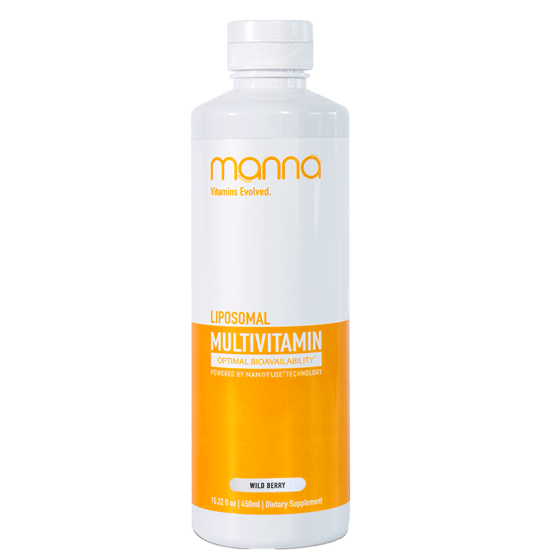
Liposomal Multivitamin
10x better absorption than traditional vitamins. The daily foundation.
Explore Manna's clinically-informed liposomal supplements.
Keep reading



Feel the difference absorption makes.
Start today, backed by our 90-day money-back guarantee. Free U.S. shipping on every subscription.