
Are Liquid Vitamins Better Than Pills? What Absorption Research Shows
By The Manna Editorial Team · August 10, 2026
9 min readLast reviewed August 11, 2026
Evidence-based. This article was written and fact-checked by the Manna Editorial Team against the peer-reviewed research cited throughout.
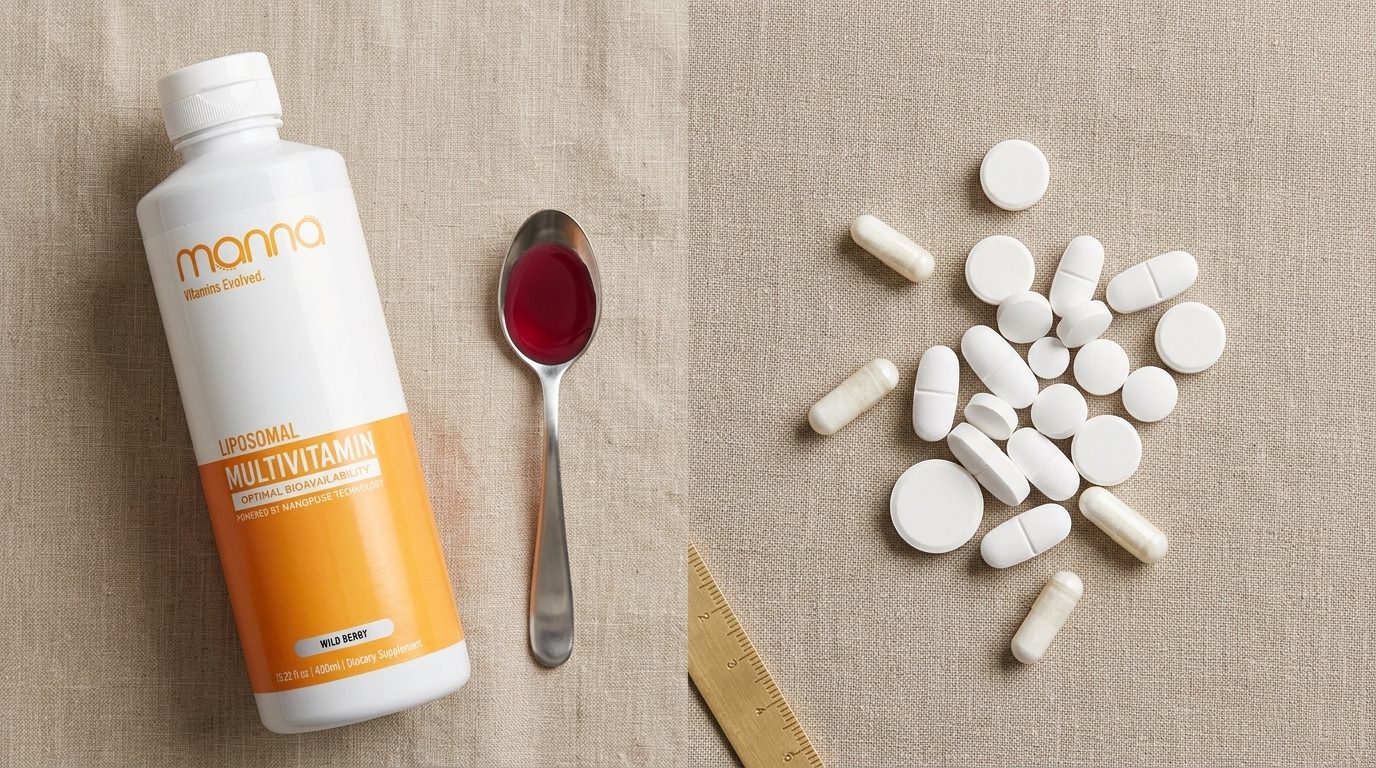
Quick answer: Liquid vitamins skip the disintegration step that tablets and capsules must clear, making them easier to swallow and absorb more quickly—but absorption ultimately depends on the nutrient's chemical form and your gut health, not just whether it's liquid. Liposomal liquid formats add an extra layer of protection that plain liquids and pills don't offer.
You've probably scrolled past ads claiming liquid vitamins absorb "98% better" than pills, or heard a friend swear that switching to liquid fixed their supplement fatigue. The premise sounds logical: liquids should reach your bloodstream faster because they don't need to break down first. Here's what's actually going on.
The format—liquid, tablet, capsule—does matter, but not in the all-or-nothing way the marketing suggests. A liquid multivitamin sidesteps one mechanical hurdle and solves real practical problems for many adults. What it doesn't do is guarantee better absorption on its own; that depends on the forms of the nutrients inside and how your digestive system handles them. This guide walks through where the liquid advantage is real, where it's oversold, and what to look for if you're considering the switch.
Why Format Affects Absorption: A Tablet Has to Disintegrate First
When you swallow a tablet or capsule, your body has to complete an extra step before any nutrient reaches your intestines: the pill must physically break apart. Tablets are compressed powders held together with binders; capsules are gelatin or cellulose shells filled with powder or beads. Both need moisture, agitation, and time to dissolve in your stomach.
The U.S. Pharmacopeia sets disintegration standards—most immediate-release tablets should break down within 30 minutes—but real-world performance varies. If a tablet uses too much binder, has a thick enteric coating, or encounters low stomach acid, it may pass through partially intact. That's not absorption failure; it's a failure to become available for absorption in the first place.
Liquids bypass this step entirely. The nutrients are already suspended or dissolved in a carrier solution, so the moment they leave your mouth, they're ready to interact with your digestive enzymes and the lining of your small intestine. This doesn't mean they absorb instantly or completely—absorption is a separate biological process—but it does remove one mechanical bottleneck.
Where Liquids Genuinely Win
Ease of Swallowing
For adults with pill fatigue, a sensitive gag reflex, or conditions that make swallowing difficult—post-surgical recovery, esophageal stricture, or simply aging—liquids solve a daily friction point. A tablespoon of liquid multivitamin is faster and less uncomfortable than working through four or five large capsules. This isn't trivial; consistent adherence matters more than theoretical potency.
Flexible Dosing
Liquids let you adjust the dose by volume. If you're starting a new supplement and want to ramp up gradually, or if you need a half-dose for a child or to pair with other supplements, a measured pour gives you control. Tablets and capsules come in fixed amounts; splitting or opening them often voids the formulation design.
Faster Breakdown
Because liquids don't need to disintegrate, they reach your small intestine—where most absorption happens—more quickly than a tablet would. For water-soluble vitamins like B-complex and vitamin C, this can mean a slightly faster appearance in the bloodstream, though the total amount absorbed may be similar once a tablet fully dissolves. The speed advantage is real; the magnitude depends on the nutrient and the individual.
Where 'Liquid' Is Oversold
The problem with the "liquids absorb better" shorthand is that it conflates format with bioavailability. Bioavailability—the fraction of a nutrient that actually enters circulation and reaches tissues—is driven primarily by the nutrient's chemical form, not whether it started as a liquid or a pill.
Take folate: a liquid multivitamin containing synthetic folic acid won't outperform a tablet containing the same folic acid, because both rely on your liver to convert it to the active form, 5-methyltetrahydrofolate. A smaller subset of people carry a gene variant that slows this conversion.[3] If the liquid contains methylfolate and the tablet contains folic acid, the liquid wins—but that's a nutrient-form advantage, not a format advantage.[5]
Magnesium offers a similar lesson. Research shows that magnesium citrate and chloride forms are absorbed more efficiently than oxide, regardless of delivery format.[1] A liquid magnesium oxide won't rescue poor absorption; a tablet of magnesium glycinate may perform better. Fat-soluble vitamins—A, D, E, K—depend on the presence of dietary fat and bile salts for absorption, no matter how they're delivered.[2]
Your gut also plays a decisive role. Individual differences in stomach acid, enzyme production, gut motility, and microbiome composition affect how much of any nutrient—liquid or solid—you absorb. A liquid won't compensate for achlorhydria or untreated celiac disease. This is why definitive, universal absorption percentages are misleading; context matters.
Liposomal Liquid vs Plain Liquid vs Tablets
Once you account for nutrient form, the next distinction is delivery protection. Not all liquids are the same. A standard liquid multivitamin suspends nutrients in water, glycerin, or juice; they're unprotected as they move through your digestive tract. Liposomal liquids wrap nutrients in phospholipid spheres—structures that mimic your cell membranes—shielding them from harsh stomach acid and digestive enzymes until they can fuse with intestinal cells.
This structure offers a measurable advantage for nutrients that are otherwise vulnerable or poorly absorbed. Liposomal delivery has been studied most extensively with vitamin C and certain nootropics, but the principle applies across a range of compounds. The key difference: liposomal liquid adds absorption protection on top of the baseline liquid advantage. (For a deeper look at how this mechanism works, see our explainer on liposomal technology.)
| Factor | Liquid (liposomal) | Liquid (standard) | Tablet/capsule |
|---|---|---|---|
| Has to disintegrate first | No | No | Yes |
| Ease of swallowing | High | High | Variable |
| Dose flexibility | Adjustable by volume | Adjustable by volume | Fixed per unit |
| Absorption protection | Phospholipid encapsulation shields from digestive breakdown | None | None (unless enteric-coated) |
| Shelf stability | Requires careful formulation; refrigeration may extend life | Shorter than pills; light/heat sensitive | Longest; stable at room temp |
Plain liquid and liposomal liquid both solve the disintegration and swallowing challenges. Liposomal adds a layer of targeted delivery that standard liquids and pills don't provide. Tablets and capsules offer convenience and shelf life, but require an intact digestive process to release their contents.
Who Benefits Most from a Liquid Multivitamin
Adults with Pill Fatigue
If you're already taking multiple prescriptions or supplements daily, adding another handful of capsules feels like a chore. A single liquid dose consolidates nutrients without adding to your pill count. Compliance improves when the routine is simpler.
People with Sensitive Stomachs
Large tablets can irritate the stomach lining, especially on an empty stomach or if they dissolve slowly. Liquids distribute more evenly and exit the stomach faster, which may reduce the nausea some people experience with dense multivitamin tablets. (If nausea is a recurring issue, this guide on timing and food pairing may also help.)
Older Adults
Aging often brings reduced stomach acid production, slower gut motility, and difficulty swallowing. Liquid formats remove two of those three barriers. For older adults managing multiple medications, a liquid multivitamin for adults can improve both adherence and comfort.
Anyone Avoiding Fillers
Tablets require binders, anti-caking agents, and sometimes coatings. Liquids can be formulated with fewer inactive ingredients, though they do need preservatives and stabilizers to prevent microbial growth and oxidation. If you have sensitivities to specific excipients, liquids may offer a cleaner ingredient deck—but check the label.
What to Check on Any Liquid Multivitamin Label
Not all liquid multivitamins are created equal. Here's what to evaluate before you buy:
- Nutrient forms: Look for bioavailable versions—methylated B vitamins (methylfolate, methylcobalamin), chelated minerals (glycinate, citrate, picolinate), and vitamin K2 (MK-7) rather than K1 when bone and cardiovascular support is a goal.[6] The liquid advantage disappears if the formula uses cheap, poorly absorbed forms.
- Dosing clarity: The label should state the exact volume of one serving (e.g., "1 tablespoon = 15 mL") and list nutrient amounts per serving. Vague instructions like "take as needed" make it impossible to track your intake.
- Preservatives and sweeteners: Liquids need stabilization. Common preservatives include potassium sorbate and sodium benzoate; common sweeteners include glycerin, stevia, or monk fruit. If you're avoiding sugar alcohols or artificial sweeteners, read the full ingredient list.
- Storage requirements: Some liquids require refrigeration after opening to maintain potency; others are shelf-stable. Check the label and plan accordingly.
- Third-party testing: Look for a certificate of analysis or a seal from NSF, USP, or an independent lab verifying label accuracy and purity. Liquids are more prone to microbial contamination than dry tablets, so quality control matters.
If you're comparing options, our bioavailability primer breaks down the nutrient-form question in more detail, and you can see how we approach formulation in our own liposomal multivitamin.
FAQ and Cautions
Do liquid vitamins work faster than pills?
They reach the small intestine faster because they don't need to disintegrate, but "faster" doesn't necessarily mean "better." For most nutrients, the total amount absorbed matters more than the speed. Water-soluble vitamins may show a quicker blood-level rise with liquids; fat-soluble vitamins depend more on what you eat with them.
Are liquid vitamins better absorbed than pills?
Not automatically. Absorption depends on the chemical form of each nutrient and your individual digestive health. Liposomal liquids offer protection that can improve absorption for vulnerable nutrients, but a standard liquid with poor nutrient forms won't outperform a well-formulated tablet.
Can I take a liquid multivitamin on an empty stomach?
You can, but fat-soluble vitamins (A, D, E, K) absorb best with a meal containing fat. Water-soluble vitamins (B-complex, C) can be taken any time. If you experience nausea, taking it with food usually helps.
How long do liquid multivitamins last after opening?
It varies by formulation. Many are stable for 30–60 days after opening if stored properly (cool, dark place or refrigerated). Always check the product label and discard after the recommended window.
Are there downsides to liquid multivitamins?
Yes. They're bulkier to travel with, may have a taste you dislike, require measuring (which adds a small step), and can be more expensive per dose than tablets. Shelf life is shorter, and they're more sensitive to light and temperature. If none of those trade-offs bother you, the benefits of liquid vitamins can outweigh the inconveniences.
Should I switch from pills to liquid?
If you struggle to swallow pills, want dose flexibility, or experience stomach discomfort with tablets, a liquid multivitamin for adults is worth considering. If you're happy with your current routine and it's working, there's no need to switch based on format alone. Nutrient quality and consistency matter more than the delivery vehicle.
Who should avoid liquid multivitamins?
People who need precise, pharmaceutical-grade dosing (e.g., for a diagnosed deficiency) should work with a healthcare provider and may require specific forms and doses that a general liquid multivitamin doesn't provide. If you have a condition affecting nutrient absorption—celiac disease, Crohn's, gastric bypass—consult your doctor before starting any supplement; format won't override an underlying malabsorption issue.
The best liquid multivitamin is the one formulated with bioavailable nutrient forms, transparent dosing, and quality controls you can verify—and that you'll actually take consistently. The format is a tool, not a miracle. Choose the delivery method that removes friction from your routine, then focus on what's inside.
These statements have not been evaluated by the Food and Drug Administration. This product is not intended to diagnose, treat, cure, or prevent any disease.
Sources
- Pardo MR et al. Bioavailability of magnesium food supplements: A systematic review. Nutrition (Burbank, Los Angeles County, Calif.) (2021).
- Borel P et al. Vitamin D bioavailability: state of the art. Critical reviews in food science and nutrition (2015).
- Scaglione F et al. Folate, folic acid and 5-methyltetrahydrofolate are not the same thing. Xenobiotica; the fate of foreign compounds in biological systems (2014).
- Various Levocarnitine. PubMed (2006).
- Pietrzik K et al. Folic acid and L-5-methyltetrahydrofolate: comparison of clinical pharmacokinetics and pharmacodynamics. Clinical pharmacokinetics (2010).
- Halder M et al. Vitamin K: Double Bonds beyond Coagulation Insights into Differences between Vitamin K1 and K2 in Health and Disease. International journal of molecular sciences (2019).
References
- 01Manna Science — Bioavailability 101 — Why absorption, not dose, is the limiting factor for many nutrients.
This article is for educational purposes only and is not medical advice. These statements have not been evaluated by the Food and Drug Administration. Manna products are not intended to diagnose, treat, cure, or prevent any disease. Consult your healthcare provider before starting any new supplement, especially if you are pregnant, nursing, taking medication, or managing a medical condition.
Frequently asked questions
Wellness that actually works
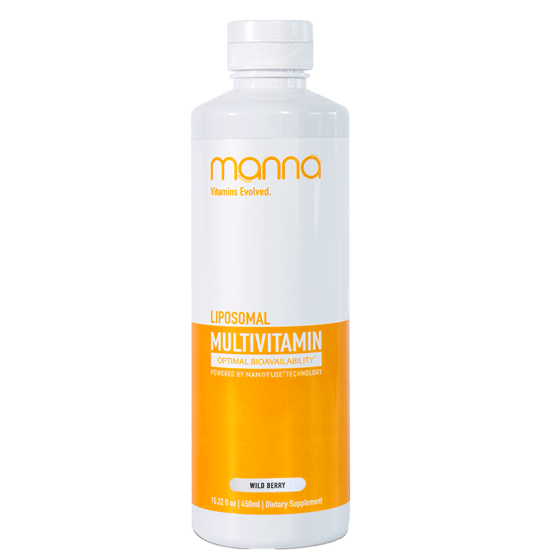
Liposomal Multivitamin
10x better absorption than traditional vitamins. The daily foundation.
Explore Manna's clinically-informed liposomal supplements.
Keep reading

Feel the difference absorption makes.
Start today, backed by our 90-day money-back guarantee. Free U.S. shipping on every subscription.