
Liposomal Curcumin vs. Regular Curcumin: Is the Upgrade Worth It?
By The Manna Editorial Team · August 10, 2026
7 min readLast reviewed August 11, 2026
Evidence-based. This article was written and fact-checked by the Manna Editorial Team against the peer-reviewed research cited throughout.
Quick answer: Liposomal curcumin wraps the active compound in a protective lipid bubble to improve absorption, addressing regular curcumin's notoriously poor bioavailability. Whether that upgrade matters depends on why you're taking it—for general wellness support, standard curcumin may suffice; for targeted goals where absorption matters, liposomal delivery offers a meaningful advantage.
Quick Answer Table
| Factor | Regular Curcumin | Liposomal Curcumin |
|---|---|---|
| Bioavailability | Very low—most passes through unabsorbed[2] | Significantly higher due to lipid encapsulation[1] |
| Cost | Lower per dose | Higher upfront, but potentially lower effective cost |
| Ideal for | General wellness support at lower doses | When absorption efficiency matters for targeted support |
| Dosing flexibility | Often requires higher doses to compensate | Lower doses may achieve comparable blood levels |
| GI tolerance | May cause mild discomfort at high doses | Generally better tolerated |
Why Regular Curcumin Under-Absorbs
Curcumin—the yellow pigment in turmeric—has a fundamental problem: your body doesn't want to let it in. When you swallow a standard curcumin capsule, the compound faces three barriers that keep most of it from reaching your bloodstream.
First, curcumin is hydrophobic. It doesn't dissolve well in the watery environment of your digestive tract, so much of it clumps together and passes through unabsorbed[2]. Second, your gut wall isn't particularly permeable to curcumin's molecular structure. Even dissolved curcumin struggles to cross the intestinal membrane into circulation. Third, what does make it through gets rapidly metabolized by liver enzymes—transformed into inactive metabolites before it can circulate[5].
The result: oral bioavailability—the fraction that reaches systemic circulation intact—is extremely low[2]. Studies consistently show that most regular curcumin never makes it into the bloodstream in active form. That's why you'll see supplement labels listing 500 mg or more per serving; manufacturers are compensating for poor absorption with higher doses.
What Liposomal Delivery Changes
Liposomal curcumin addresses the absorption problem with a delivery system borrowed from pharmaceutical science. The curcumin molecules are encapsulated inside tiny spheres called liposomes—microscopic bubbles made from the same phospholipids that form your cell membranes[1].
This changes the absorption dynamic in three ways. The lipid shell solubilizes the curcumin, keeping it dispersed in your digestive fluids instead of clumping. The liposome structure is recognized by your intestinal cells as similar to their own membranes, facilitating uptake. And some portion of the curcumin remains protected inside the liposome as it crosses the gut wall, shielding it from immediate metabolism[4].
The practical outcome: more curcumin reaches your bloodstream in active form per milligram consumed. You can read more about the underlying mechanism in our liposomal encapsulation explainer.
How Much Better Is the Absorption?
Here's where the evidence gets murkier. You'll see manufacturers claim "10× better absorption" or similar multiples, but those figures often come from proprietary, non-peer-reviewed studies or extrapolations that don't reflect real-world use. The peer-reviewed literature confirms that liposomal and other nanoformulations improve curcumin bioavailability[1][4], but specific fold-improvements vary widely depending on formulation, study design, and what you're measuring (blood levels, tissue levels, metabolite profiles).
The conservative summary: liposomal delivery substantially improves absorption compared to unformulated curcumin powder. The exact magnitude depends on the specific product and individual physiology.
An Honest Look at the Evidence
The research on enhanced curcumin formulations—including liposomal, nanoparticle, and phytosome versions—shows consistent improvement in bioavailability metrics[3][1]. Multiple reviews have documented that these delivery systems help overcome curcumin's poor absorption[4]. That part is well-established.
What's less clear is which specific health outcomes require that improved absorption—and at what dose. Most clinical trials of curcumin's effects on inflammation markers, joint comfort, or other endpoints used high doses of standard curcumin, enhanced formulations, or combinations with piperine (black pepper extract, which inhibits curcumin metabolism). Fewer studies have directly compared standard versus liposomal at equivalent doses in humans for functional outcomes.
The evidence does NOT support claims that curcumin—liposomal or otherwise—treats, cures, or prevents any disease. When reading about curcumin research, distinguish between what happens in cell cultures or animal models (interesting, but preliminary) and what's been demonstrated in controlled human trials (more reliable, but often limited to specific contexts).
What we can say: if your goal involves systemic curcumin levels—supporting a healthy inflammatory response throughout the body, for example—the absorption difference between liposomal curcumin and standard powder is likely meaningful. For effects that may occur locally in the gut (where curcumin concentration is high regardless of systemic absorption), the difference may matter less.
Safety and Tolerance Considerations
Both standard and liposomal curcumin have good safety profiles at typical supplement doses. The liposomal format may offer a tolerance advantage at higher doses, since it requires less total curcumin to achieve similar blood levels. Some people experience mild GI upset with large doses of regular curcumin; liposomal delivery may reduce that risk simply by reducing the required dose.
The long-term safety data on nanoformulated curcumin is still developing. One review notes that while enhanced delivery improves therapeutic potential, questions remain about long-term effects of nanomaterials themselves[6]. This isn't a red flag—it's the normal state of newer delivery technologies. Liposomal encapsulation uses well-studied phospholipids, which have a long safety record.
When Regular Curcumin Is Fine vs. When Liposomal Is Worth It
Standard curcumin may be sufficient when:
- You're using it primarily as a culinary spice or for general wellness support at low doses
- You're taking it with fats (which aid absorption) or piperine (which slows metabolism)
- You're prioritizing cost over absorption efficiency
- You're okay taking higher milligram doses to compensate for lower bioavailability
- Your goals relate to gut health, where local concentration matters more than systemic absorption
Liposomal curcumin offers clearer advantages when:
- You want to minimize total curcumin dose while maximizing blood levels
- You've tried standard curcumin at reasonable doses without noticing the support you expected
- You prefer not to combine curcumin with piperine (which can affect how your body metabolizes other compounds and medications)
- You have GI sensitivity to higher doses of regular curcumin
- Your focus is on systemic support—maintaining healthy joints, supporting a balanced inflammatory response, or similar whole-body goals
The decision isn't binary. Some people start with standard curcumin and switch to liposomal if they don't notice the support they're looking for. Others begin with liposomal formulations to avoid the trial-and-error phase. Both approaches are reasonable.
For context on how liposomal curcumin compares to another enhanced format, see our article on curcumin phytosome vs liposomal curcumin.
Frequently Asked Questions
Is liposomal curcumin better than regular curcumin for everyone?
"Better" depends on your priorities. Liposomal curcumin is more efficiently absorbed, which matters if you want higher blood levels with lower doses or if standard curcumin hasn't provided the support you expected. For general use or cooking, regular curcumin works fine. There's no universal answer—it's about matching the format to your specific goals.
Can I just take more regular curcumin instead of switching to liposomal?
You can, and that's the strategy many supplements use—listing 500 mg or more per serving. But there's a practical ceiling. Beyond a certain dose, you're adding cost and pill burden without proportional benefit, and some people experience digestive discomfort. Liposomal delivery lets you achieve comparable or higher blood levels with less total curcumin.
How do I know if liposomal vs standard curcumin is making a difference?
You won't feel absorption happening. The clearest indicator is whether you notice the support you're taking it for—joint comfort, recovery, or other wellness goals—at a reasonable dose. If you've tried standard curcumin at 500-1000 mg daily for several weeks without the support you expected, a liposomal format may be worth testing. Keep in mind that individual responses vary, and curcumin is not a pharmaceutical with immediate, predictable effects.
Should I take liposomal curcumin with food or on an empty stomach?
Liposomal formulations are designed to be less dependent on food for absorption than standard curcumin, but taking them with a small amount of fat may still help. Follow the specific instructions on your product label. If none are provided, taking it with a meal is a safe default.
Are there people who shouldn't take curcumin supplements?
Curcumin can interact with certain medications, particularly blood thinners and drugs metabolized by specific liver enzymes. If you're pregnant, nursing, scheduled for surgery, or taking prescription medications, consult your healthcare provider before starting any curcumin supplement—liposomal or otherwise. This is true for all supplements, not a unique concern with liposomal formats.
What should I look for when choosing a liposomal curcumin product?
Third-party testing for purity and potency, clear labeling of curcumin content (not just total turmeric extract), and transparent sourcing. Not all "liposomal" products use genuine liposomal encapsulation; some use the term loosely for any fat-based delivery. Look for brands that provide details about their encapsulation process and phospholipid sources.
The choice between liposomal curcumin and regular curcumin isn't about one being universally superior—it's about absorption efficiency and what that means for your specific use case. If you're considering an upgrade, you now have the framework to decide whether the improved bioavailability justifies the cost for your goals. As with any supplement decision, consult a healthcare professional if you have underlying health conditions or take medications.
These statements have not been evaluated by the Food and Drug Administration. This product is not intended to diagnose, treat, cure, or prevent any disease.
Sources
- Obeid MA et al. Recent updates in curcumin delivery. Journal of liposome research (2023).
- Liu W et al. Oral bioavailability of curcumin: problems and advancements. Journal of drug targeting (2016).
- Lu KH et al. Curcumin and its Analogs and Carriers: Potential Therapeutic Strategies for Human Osteosarcoma. International journal of biological sciences (2023).
- Ghalandarlaki N et al. Nanotechnology-applied curcumin for different diseases therapy. BioMed research international (2014).
- Hassanzadeh K et al. Obstacles against the Marketing of Curcumin as a Drug. International journal of molecular sciences (2020).
- Janjua KA et al. Nanocurcumin: A Double-Edged Sword for Microcancers. Current pharmaceutical design (2020).
- Standard curcuminLow
- Curcumin + piperineModerate
- Liposomal curcuminHigh
Illustrative comparison based on published bioavailability research — not a single head-to-head trial. Individual results vary.
References
- 01Manna Science — Liposomal Delivery — How liposomal encapsulation improves nutrient absorption.
This article is for educational purposes only and is not medical advice. These statements have not been evaluated by the Food and Drug Administration. Manna products are not intended to diagnose, treat, cure, or prevent any disease. Consult your healthcare provider before starting any new supplement, especially if you are pregnant, nursing, taking medication, or managing a medical condition.
Frequently asked questions
Wellness that actually works
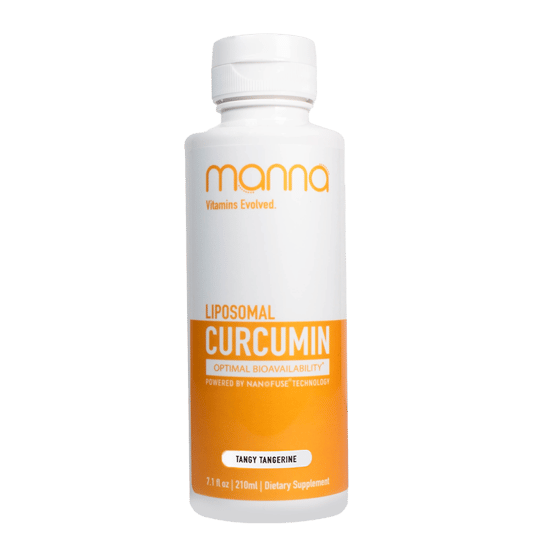
Liposomal Curcumin
The original. Supports natural comfort and a healthy inflammatory response.
Explore Manna's clinically-informed liposomal supplements.
Keep reading
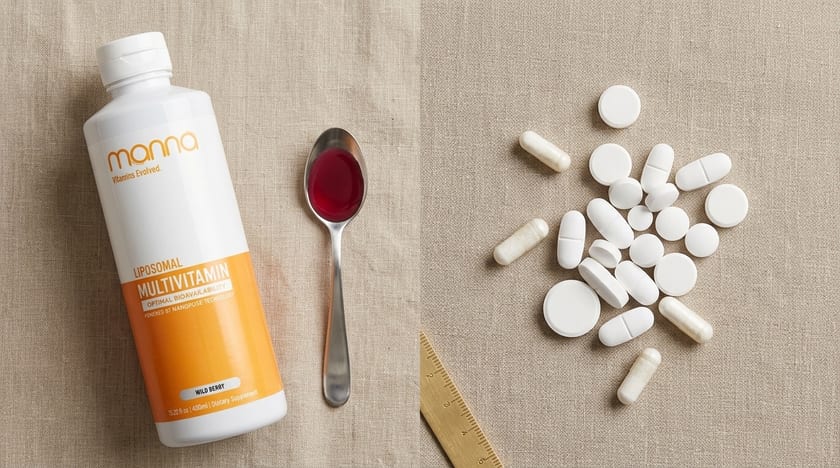

Feel the difference absorption makes.
Start today, backed by our 90-day money-back guarantee. Free U.S. shipping on every subscription.