
How Much Turmeric Is Too Much? Dosage, Safety, and Interactions
By The Manna Editorial Team · August 10, 2026
8 min readLast reviewed August 11, 2026

Evidence-based. This article was written and fact-checked by the Manna Editorial Team against the peer-reviewed research cited throughout.
Quick answer: For standardized curcumin (the active compound in turmeric), research suggests doses up to 8,000–12,000 mg per day are generally well tolerated in short-term studies, though most supplementation protocols use 500–2,000 mg daily. What counts as "too much" depends on the form you're taking, your health status, and what medications you use.
You've heard that curcumin—the polyphenol that gives turmeric its golden color—supports a healthy inflammatory response and cellular health. Maybe your doctor mentioned it, or a podcast made it sound like a staple. So you added it to your routine. Then you started wondering: Can I take this with my other medications? Is there such a thing as too much?
Here's what's actually going on. Turmeric and its extracts occupy an unusual place in the supplement landscape—generally regarded as safe, yet capable of meaningful interactions at higher doses or in certain formulations. Understanding how much turmeric is too much requires looking not just at milligrams, but at bioavailability, individual health factors, and what else you're putting in your body.
General Dosing Guidance for Turmeric and Curcumin
First, a distinction: whole turmeric root powder contains roughly 3% curcumin by weight. Standardized curcumin extracts concentrate that active fraction to 95% or higher. This matters because the research uses both, and the safe upper limits differ accordingly.
The Joint FAO/WHO Expert Committee on Food Additives has established an acceptable daily intake of 0–3 mg per kilogram of body weight for curcumin[1]. For a 70 kg adult, that translates to roughly 210 mg of curcumin per day as a conservative benchmark. Clinical trials, however, have tested much higher doses—often 500–2,000 mg of curcumin daily—without serious adverse events in healthy adults[2].
Some studies have pushed the envelope further. Doses up to 8,000–12,000 mg per day have been used in short-term oncology research, with participants reporting mild gastrointestinal discomfort but no severe toxicity[5]. These are not general recommendations—they're supervised protocols in specific contexts. For everyday supplementation, most manufacturers and researchers land between 500–1,000 mg of a standardized extract taken once or twice daily.
If you're using turmeric root powder in cooking or as a supplement, the curcumin dose is much lower. A teaspoon of turmeric powder (roughly 3 grams) delivers only about 90 mg of curcumin. It's difficult to reach problematic levels through culinary use alone.
Signs You're Taking Too Much Turmeric
Turmeric's safety profile is good, but it's not unlimited. The most common sign of excess intake is gastrointestinal upset—nausea, diarrhea, or stomach cramping. These symptoms typically appear at doses above 1,500–2,000 mg of curcumin per day and resolve when the dose is reduced.
Other reported effects at high doses include:
- Headache or dizziness — less common, but documented in a subset of users at doses exceeding 3,000 mg daily.
- Skin rash — rare contact dermatitis or allergic reactions, more often seen with topical application or high oral doses[4].
- Lowered blood sugar — curcumin may modestly support healthy glucose metabolism, but in combination with diabetes medications, excessive intake could contribute to hypoglycemia.
- Increased bleeding risk — discussed in detail below; relevant mainly when combined with anticoagulants.
If you experience persistent digestive symptoms, unusual bruising, or any allergic reaction after starting turmeric, stop supplementation and consult your healthcare provider.
Turmeric and Medications: Key Interactions to Know
This is where dosing conversations get serious. Curcumin influences several metabolic pathways, and those effects can amplify or interfere with pharmaceutical drugs.
Blood Thinners (Anticoagulants and Antiplatelets)
Curcumin has been shown in laboratory studies to inhibit platelet aggregation—the clumping of blood cells that forms clots. In isolation, this effect is mild. But if you're taking warfarin, clopidogrel, aspirin, or other anticoagulants, adding high-dose turmeric can theoretically increase bleeding risk. The evidence in humans is limited, but the mechanism is plausible enough that caution is warranted.
If you're on blood thinners and considering turmeric supplementation, discuss it with your prescribing physician. Monitoring INR (for warfarin users) or watching for unusual bruising is prudent when starting or changing doses.
Diabetes Medications
Curcumin may support healthy metabolic function, including glucose regulation[6]. For someone managing blood sugar with metformin, sulfonylureas, or insulin, that effect could add up—potentially lowering glucose more than intended. Again, the interaction isn't well quantified in clinical settings, but the direction of effect is consistent across preclinical work.
If you have diabetes and take medication, monitor your blood sugar more closely when introducing turmeric and talk to your doctor about whether dosage adjustments are necessary.
Cytochrome P450 Interactions (Especially with Piperine)
Many turmeric supplements include black pepper extract—specifically piperine—to enhance absorption. Piperine works in part by inhibiting CYP3A4, an enzyme responsible for metabolizing a large fraction of prescription drugs. This can increase blood levels of medications processed through that pathway, including statins, some blood pressure drugs, immunosuppressants, and benzodiazepines.
The effect is dose-dependent. A pinch of black pepper in food is negligible. But a supplement delivering 10–20 mg of piperine alongside curcumin can meaningfully slow drug clearance. If you take multiple prescriptions, an absorption-enhanced turmeric product without piperine—such as a liposomal formulation—may be a safer choice.
Who Should Be Especially Cautious with Turmeric
Even within typical dosing ranges, certain individuals face elevated risk and should approach turmeric supplementation conservatively—or avoid it altogether until they've consulted a healthcare provider.
Gallstones or Bile Duct Obstruction
Curcumin stimulates bile production, which supports fat digestion under normal conditions. But if you have gallstones or a blocked bile duct, increased bile flow can worsen pain or trigger a gallbladder attack. If you have a history of gallbladder disease, turmeric supplementation is not recommended without medical clearance.
Pregnancy and Breastfeeding
Turmeric as a culinary spice is considered safe during pregnancy. High-dose curcumin supplements, however, have not been adequately studied in pregnant or breastfeeding populations. There is theoretical concern that large amounts could stimulate the uterus or affect fetal development. Until more data exist, pregnant and nursing individuals should stick to food-level amounts and avoid concentrated extracts.
Kidney Stones and High Oxalate Levels
Turmeric contains oxalates—naturally occurring compounds that can contribute to kidney stone formation in susceptible individuals. If you have a history of calcium oxalate stones or chronic kidney disease, high intake of turmeric (especially the root powder) may not be advisable. Curcumin extracts contain fewer oxalates than whole turmeric, but if you're at risk, discuss supplementation with your nephrologist or dietitian.
Upcoming Surgery
Because of turmeric's potential antiplatelet effects, many surgeons recommend discontinuing supplements two weeks before a scheduled procedure to reduce bleeding risk. This is a standard precaution for many botanicals and should be part of your pre-operative checklist.
How Absorption-Enhanced Forms Change the Dosing Math
Standard curcumin is poorly absorbed—most of an oral dose never reaches systemic circulation. This is why traditional dosing recommendations are surprisingly high; you're compensating for low bioavailability.
Enhanced-delivery systems flip that equation. Liposomal curcumin, for example, encapsulates the compound in phospholipid vesicles that merge with intestinal cell membranes, dramatically increasing absorption. Other technologies—nanoparticles, phytosomes, or formulations with fats—achieve similar results.
The practical upshot: an absorption-enhanced product delivering 250 mg of curcumin may produce blood levels comparable to 1,500 mg of standard extract. This is a feature, not a bug—you get the effect with a smaller pill and less risk of GI upset. But it also means you need to read labels carefully. "How much turmeric is too much" depends heavily on which kind you're taking.
If you're switching from a standard extract to an enhanced form, don't assume you can take the same milligram dose. Start lower and assess tolerance. The safety ceiling for enhanced curcumin hasn't been as exhaustively tested as standard forms, simply because the technology is newer.
Frequently Asked Questions About Turmeric Dosage and Safety
Can you take turmeric every day?
Yes, for most healthy adults. Long-term studies lasting several months have not identified major safety concerns with daily curcumin supplementation at typical doses (500–1,000 mg). Culinary use is even less of a concern. That said, "safe for most" doesn't mean "safe for all"—individual factors matter.
Is it better to take turmeric with food?
Yes, especially if it's a standard extract. Curcumin is fat-soluble, so taking it with a meal that contains some dietary fat improves absorption. Enhanced formulations are less dependent on food timing, but taking any supplement with food tends to reduce the chance of stomach upset.
What about turmeric tea or golden milk?
These preparations are generally safe and pleasant, but they deliver very modest amounts of curcumin—often less than 50 mg per serving. They're unlikely to cause problems, but also unlikely to produce the effects seen in clinical trials unless consumed in large volumes.
Should I cycle off turmeric periodically?
There's no established need to cycle turmeric supplementation if you're tolerating it well and staying within recommended doses. Some practitioners suggest occasional breaks as a general principle with any supplement, but the evidence base doesn't demand it for curcumin specifically.
Can turmeric supplements cause liver damage?
Rare case reports have linked high-dose turmeric supplements to liver injury, but causality is difficult to establish—many involved products with undisclosed ingredients or contaminants. High-quality, third-party tested curcumin extracts have not been shown to cause liver toxicity at standard doses in controlled studies. If you have pre-existing liver disease, talk to your doctor before supplementing.
The Bottom Line: Dose Matters, Context Matters More
Turmeric and curcumin occupy a sweet spot in the supplement world—potent enough to matter, safe enough for widespread use, but not without boundaries. For most people, 500–1,000 mg of curcumin daily (or the equivalent in an enhanced-absorption product) sits comfortably within the evidence-supported range. Higher doses may be appropriate in specific circumstances, but they're not inherently better and come with a higher chance of side effects or interactions.
The question "how much turmeric is too much" doesn't have a universal answer. It depends on the form you choose, the medications you take, your medical history, and what you're hoping to achieve. If you're on blood thinners, managing diabetes, pregnant, or dealing with gallbladder or kidney issues, turmeric supplementation is worth a conversation with your healthcare provider before you start.
If you're healthy and considering turmeric as part of a broader wellness strategy, understanding what the compound does—and what it doesn't—puts you in a better position to use it intelligently. Start conservatively, pay attention to how your body responds, and remember that more isn't always better. The goal isn't to maximize dosage; it's to find the amount that supports your health without creating new problems.
When in doubt, ask your doctor. That's not a disclaimer—it's the most rational step in any supplement decision.
These statements have not been evaluated by the Food and Drug Administration. This product is not intended to diagnose, treat, cure, or prevent any disease.
Sources
- Various Turmeric. PubMed (2006).
- Ng QX et al. Clinical Use of Curcumin in Depression: A Meta-Analysis. Journal of the American Medical Directors Association (2017).
- Kantasa T et al. Therapeutic Potential of Curcumin and Novel Formulations in Psoriasis Treatment: Evidence and Future Prospects. Drug design, development and therapy (2025).
- Vollono L et al. Potential of Curcumin in Skin Disorders. Nutrients (2019).
- Yang ZJ et al. Effects and Mechanisms of Curcumin for the Prevention and Management of Cancers: An Updated Review. Antioxidants (Basel, Switzerland) (2022).
- Nosrati-Oskouie M et al. Impact of curcumin on fatty acid metabolism. Phytotherapy research : PTR (2021).
References
- 01NIH Office of Dietary Supplements — Turmeric — Safety, dosing, and interaction considerations for curcumin.
This article is for educational purposes only and is not medical advice. These statements have not been evaluated by the Food and Drug Administration. Manna products are not intended to diagnose, treat, cure, or prevent any disease. Consult your healthcare provider before starting any new supplement, especially if you are pregnant, nursing, taking medication, or managing a medical condition.
Frequently asked questions
Wellness that actually works
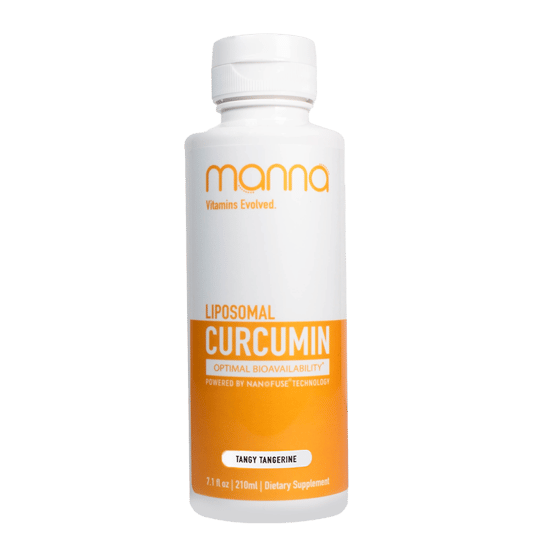
Liposomal Curcumin
The original. Supports natural comfort and a healthy inflammatory response.
Explore Manna's clinically-informed liposomal supplements.
Keep reading


Feel the difference absorption makes.
Start today, backed by our 90-day money-back guarantee. Free U.S. shipping on every subscription.